When inquiries arrive but sales do not, it is easy to call the leads poor quality. That label may hide the real problem. Some people want a service you do not offer. Others are a good fit but never receive a useful reply. Both end without a sale, and they call for different fixes.
I would check lead quality by reviewing actual inquiries, not by assigning a score to every form submission. The aim is to decide whether your marketing is reaching suitable buyers and whether those buyers are getting a fair chance to take the next step.
What makes a lead good quality?
For a small service business, a good-quality lead is an inquiry from someone whose problem your service can address, who falls within the work you can take on, and who has shown enough interest for a sensible next conversation. That does not mean they will buy. It means the inquiry was worth handling properly.
Write the criteria for the particular service before you review the records. A monthly bookkeeping firm might ask whether the person wants ongoing bookkeeping, has a business the team serves, and can describe a current need. A request for tax litigation would be a poor fit. A suitable business that asks for a consultation and receives no reply is a handling failure, not evidence of a bad lead.
Keep missing information separate from disqualification. A short contact form may not reveal timing or budget. Mark those as unknown until someone asks. Mailchimp describes fit, interest, readiness, budget, and authority as possible lead-quality factors. I would use only the factors that help this business decide what to do next.
Google Analytics also distinguishes submitted, qualified, disqualified, contacted, and converted leads in its recommended events. You can preserve those distinctions in a spreadsheet even if you do not use those events. A form submission is a starting point, not a qualification decision or a sale.
Review one set of inquiries
Choose one service and a dated period that makes sense for its sales cycle. Pull the inquiries from every place they reached you: forms, calls, booking requests, referrals, and the inbox. If a buyer contacted you twice about the same job, treat that as one inquiry with two contacts. Keep a separate record for a genuinely new request.
Use the fields below. An identifier is enough for a shared review sheet; keep personal details in the system where your team handles the customer. Record what you know, and write unknown where the evidence is missing.
| Field | What to record |
|---|---|
| Inquiry and date | A distinct request and when it arrived. |
| Source | Where it came from, or unknown. Note whether the source is confirmed or reported by the buyer. |
| Service fit | Fits, does not fit, or needs more information, with a short reason. |
| Handling | Who owned the reply, whether the buyer was reached, and the next action offered. |
| Current outcome | Won, declined, still open, or unknown, with the reason when you have one. |
Do not force every record into a win or loss. A buyer still comparing options may be open. An inquiry with no recorded reply has an unknown sales outcome and a visible handling problem. If your records cannot show where a form request went, check the delivery path in my website conversion audit before judging that source of leads.
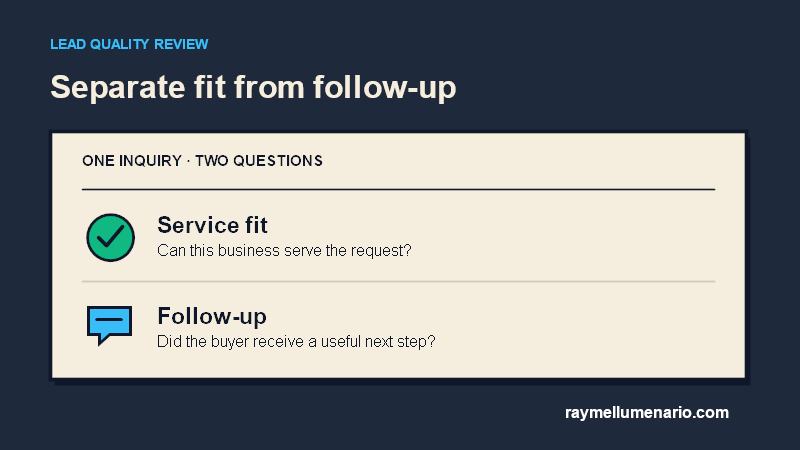
Separate lead quality from what happened afterward
Sort the reviewed inquiries into four groups. The group matters more than a single overall conversion rate because it points to a different next action.
| What the records show | What to check next | First action |
|---|---|---|
| Requests clearly outside the service you sell | Which source and message brought them in? | Clarify the offer or adjust targeting for that source. |
| Suitable inquiries with no useful response or next step | Did they reach an owner, and could that person respond? | Repair the handoff or response process. |
| Suitable buyers who spoke with you but did not proceed | What reason did they give, and at which step? | Review the offer, proposal, availability, or sales conversation indicated by the evidence. |
| Many records still open or missing key facts | Can you identify fit and current status reliably? | Complete the records before changing a campaign. |
A low lead-to-customer rate on its own cannot tell you which row applies. Nor should a missed reply turn a suitable buyer into a “bad lead” in the report. Keep the buyer-fit decision and the handling outcome as separate fields.
Worked example: eight bookkeeping inquiries
This example is hypothetical. It shows how to use the review, not a typical conversion rate or a client result.
A four-person bookkeeping business reviews eight inquiries received during one month. Two request work it does not offer. Two ask about ongoing bookkeeping but receive no useful reply because the shared inbox has no clear owner. One suitable buyer reaches a proposal and declines, giving a specific reason about the service scope. One becomes a client. One is still deciding. The last inquiry lacks enough information to judge fit.
Calling six of the eight “bad leads” would lead the team toward the wrong fix. It has evidence of two poor-fit requests and two suitable buyers lost in handling. It also has one later sales objection worth examining, one open conversation, and one unknown. I would first make sure every suitable inquiry reaches an owner and receives a clear next step. Then I would review whether the sources continue to bring requests the business cannot serve.
Eight inquiries are too few to declare a channel good or bad from a percentage alone. The records can still reveal a process failure that the team can test and repair. Keep the service and period visible when you review a later set of inquiries.
Make one change, then review the next set
Choose the first action from the observed problem. If unsuitable requests cluster around one campaign, compare its promise and targeting with the service. If suitable inquiries wait without a reply, assign ownership and check that the next request reaches that person. If buyers reach proposals but decline for a repeated, stated reason, investigate that reason before changing the source of inquiries.
Record when you made the change. Review a later period for the same service, keeping the source, open deals, and changes in workload visible. Look for a clear improvement in the step you changed. A handful of outcomes may raise a useful question, but it will not prove that the whole channel improved.
If the review shows too few suitable inquiries in the first place, my lead generation strategy guide helps you choose an acquisition approach your team can run. If suitable inquiries reach your business but records, ownership, or follow-up repeatedly fail, use my CRM health check to examine that handoff.
The useful outcome of a lead-quality review is one specific decision: improve who you attract, repair how you handle good inquiries, examine a later sales loss, or collect the missing facts. Write down which decision the evidence supports before you spend more to bring in the next set of leads.