Most businesses are measuring marketing ROI wrong. Not because they’re using the wrong tools. Because they’re measuring the wrong things.
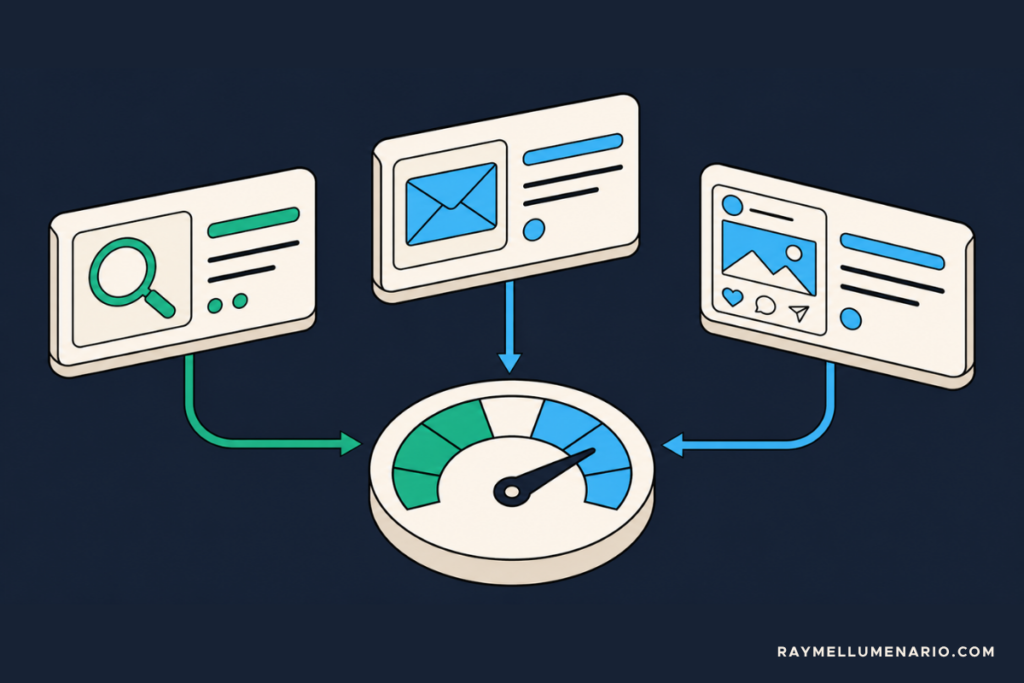
I’ve worked with teams spending real money across four channels simultaneously — with no clear answer to one question: which of these is actually working? The problem is almost never the analytics tool. Nobody agreed on what to count before they started spending. So when the numbers came in, there was nothing to compare them against.
This post gives you the framework to measure marketing ROI accurately, with tools you already have.
The direct answer: Marketing ROI is calculated as ((Revenue from Marketing − Marketing Cost) ÷ Marketing Cost) × 100. A 5:1 return (500%) is the baseline target for most businesses. To track it without enterprise software, you need four things: a way to capture lead source, a record of deal value, close rate by channel, and a consistent review cadence. Everything else is context.
What Marketing ROI Actually Measures (and What It Doesn’t)
The formula is simple. The inputs are where most teams get sloppy.
Marketing ROI = ((Revenue from Marketing − Marketing Cost) ÷ Marketing Cost) × 100
A 300% result means three dollars back for every dollar spent. Below 0% means the channel is losing money. What the formula doesn’t tell you on its own: which channel drove the revenue, whether the return is repeatable, or how much of your own time went into generating it.
Those gaps are where the real tracking work happens.
The Two Inputs Most Teams Define Too Loosely
Revenue from marketing: Only count revenue traceable to a specific marketing activity. Referrals with no clear origin, word-of-mouth, and inbound calls you can’t attribute don’t belong here unless you have a way to tie them to a source. If you can’t trace it, don’t count it.
Marketing cost: Include ad spend, tool subscriptions, contractor fees, and your own time. Founders almost always leave their hours out of the calculation — if you spend 10 hours a week on content and your time is worth $100 an hour, that’s $1,000 per month in hidden costs per channel. Include it or the ROI number is fiction.
The 3 Mistakes Lean Teams Make When Calculating Marketing ROI
Mistake 1: Measuring total revenue against total spend. This hides which channels work and which don’t. You end up optimizing the average instead of the winner. Break every calculation down by channel first.
Mistake 2: Leaving your own time out of the cost. Channels that look profitable without this often break even or worse when you count it. This is especially true for organic social and content, which can absorb 10 or more hours per week with deceptively low visible returns.
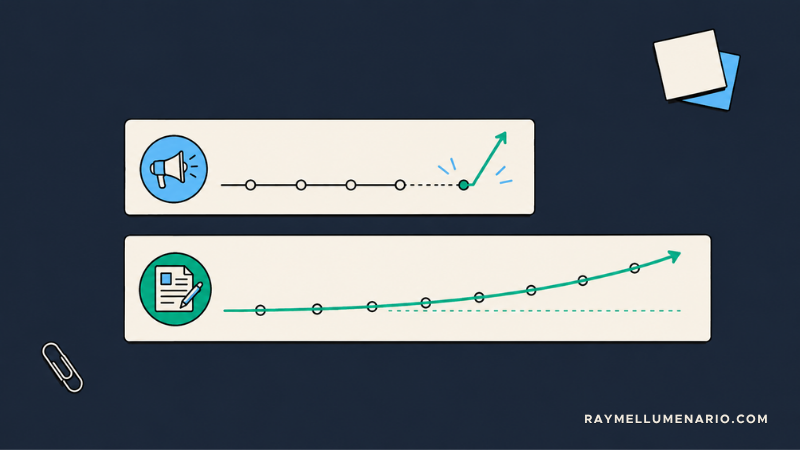
Mistake 3: Comparing channels on the same measurement window regardless of their return cycle. Paid ads show ROI within 72 hours. Content marketing compounds over 12 to 18 months. Measuring both over 30 days will always make paid look better, even when it isn’t. This is the timeframe trap, and almost no ROI guide addresses it directly.

How to Track Marketing ROI Without Expensive Tools
You need four things: UTM parameters on every link, a place to record lead source and deal value, a monthly review slot on your calendar, and a rule that source data gets logged at the point of first contact — not after the sale.
For UTM parameters: Google Analytics 4 reads them natively and it’s free. Every link you share in ads, email, or social gets a UTM. If you skip this step, you’re attributing by memory, and memory is wrong.
For recording leads and deals: a CRM on the free tier, or a Google Sheet with four columns — source, lead date, close date, deal value. The tool doesn’t matter. The habit does.
The 5 Numbers That Actually Tell You If a Channel Is Working
You don’t need a dashboard. You need these five numbers per channel.
1. Cost per lead (CPL). What does one lead cost from this channel? If your CPL exceeds what your average deal value and close rate can support, the channel is losing money before you’ve made a single sale.
2. Lead-to-customer conversion rate. What percentage of leads from this channel actually buy? A channel with a higher CPL but stronger close rate can outperform a cheaper channel that rarely converts — this number is what tells you which is which.
3. Average deal value. A channel sending five small clients may return less than one sending a single large one, even if the lead volume looks better.
4. Customer payback period. How long until a customer’s revenue covers what you spent to acquire them? If the payback period runs longer than your average contract or cash cycle, the channel is structurally unprofitable — even if the ROI looks fine on paper.
5. Lifetime value (LTV). Total revenue over the full customer relationship, not just the first invoice. This is what makes channel comparisons honest. A channel building long-term clients will always look weak in a 30-day window until you account for what those clients are worth over 12 months.
These five, tracked consistently, tell you which channels to scale and which to cut.
Marketing ROI: A measure of the revenue a marketing activity generates relative to what it costs, expressed as a percentage. Calculated as ((Revenue Attributed to Marketing − Marketing Cost) ÷ Marketing Cost) × 100. Unlike reach or engagement metrics, marketing ROI ties spend directly to business outcomes and is the only number that tells you whether a channel is worth keeping.
What Does a Good Marketing ROI Look Like?
The widely cited benchmarks in direct-response marketing: 5:1 (500%) is solid for most businesses, 10:1 (1000%) is exceptional, and below 2:1 (200%) is typically marginal once operational costs are factored in.
Context matters more than the number. A 400% ROI from a channel with a two-week sales cycle is not the same as a 400% ROI from a channel with a six-month one. The payback period determines whether you can reinvest returns before the next spend cycle hits.
The Timeframe Problem That Makes Most Channel Comparisons Meaningless
This is the insight that changes how most founder-led teams think about channel allocation: every channel has a different return cycle, and comparing them on the same clock produces misleading conclusions.
Paid ads: ROI visible within 24 to 72 hours. Blog content: full compounding return takes 12 to 18 months. If you measure both over a 30-day window, paid wins every time — even if the content is building a larger long-term return at a lower acquisition cost.
The fix: assign each channel its own measurement window. Paid monthly. Quarterly for organic search. Semi-annual for content. Stop comparing them on the same clock.
Is Social Media ROI Actually Measurable?
Direct ROI: yes. Track link clicks with UTMs, tie them to conversions in GA4. This gives you a clean number for clicks that converted directly from social.
Indirect ROI: harder to measure, but real. Someone follows you for two months, then converts through a branded search. GA4 credits organic search. But social created the intent. That return is invisible to most tracking setups.
The fix is simple and underused: ask. A “how did you find us?” field on your contact form or during onboarding surfaces what analytics can’t. Self-reported attribution is imperfect, but for teams under 100 leads a month, it’s often more useful than any automated model.
A Simple ROI Tracking System You Can Build Today
No tool required. Four tabs in a Google Sheet:
- Channels: Every active channel, monthly spend, and primary goal (leads, traffic, or direct revenue).
- Leads: Source pulled from UTM or CRM, date, and current status.
- Customers: Closed deals with source channel and deal value.
- Monthly Summary: Formulas for CPL, conversion rate, and ROI per channel. Nothing else.
First setup takes two to three hours. Monthly upkeep takes 20 minutes. For configuring UTM parameters in GA4, Google’s campaign parameters guide is the cleanest reference to start from.
Want the Google Sheet pre-built?
I put together a free template with all four tabs and pre-loaded formulas for CPL, conversion rate, and ROI by channel. Drop your email and I’ll send it over.
Frequently Asked Questions About Marketing ROI
What is the basic marketing ROI formula?
Marketing ROI = ((Revenue from Marketing − Marketing Cost) ÷ Marketing Cost) × 100. A result of 500% means you returned five dollars for every dollar spent. The formula is only as accurate as the inputs — define what counts as revenue from marketing and what counts as cost before you calculate.
What is a good marketing ROI percentage?
A 500% ROI (5:1) is a solid baseline for most businesses. A 1000% ROI is exceptional. Below 200% is typically marginal once you account for operational overhead and your own time. The right benchmark depends on your margins, your sales cycle length, and whether you’re measuring direct or lifetime returns.
Can I measure marketing ROI without a CRM?
Yes. A spreadsheet with lead source, deal status, close date, and deal value gives you everything you need at the early stages. The non-negotiable: log the source at the point of first contact. Waiting until after the sale closes means you’re guessing at attribution, not tracking it.
Why does my content marketing ROI always look low?
Almost certainly because you’re measuring it on a 30-day window. Content compounds over 12 to 18 months. Evaluate it quarterly or semi-annually, not monthly. A post that drives zero conversions in its first month may drive 80% of your organic traffic by month 14.
Should I include my own time when calculating marketing ROI?
Yes, always. Assign an hourly rate to your time and add hours spent per channel to the cost side. Channels that look profitable without this often break even or worse when you count it. This is especially true for organic social, which can absorb 10 or more hours per week with deceptively low direct returns.