More of your prospects are asking ChatGPT, Perplexity, and Google’s AI Overviews the questions they used to type into Google: who’s a good option for this, what tool handles that, how do I fix this problem. Getting cited in that answer depends less on your Google ranking than it used to, though exactly how much less varies from one system to the next.
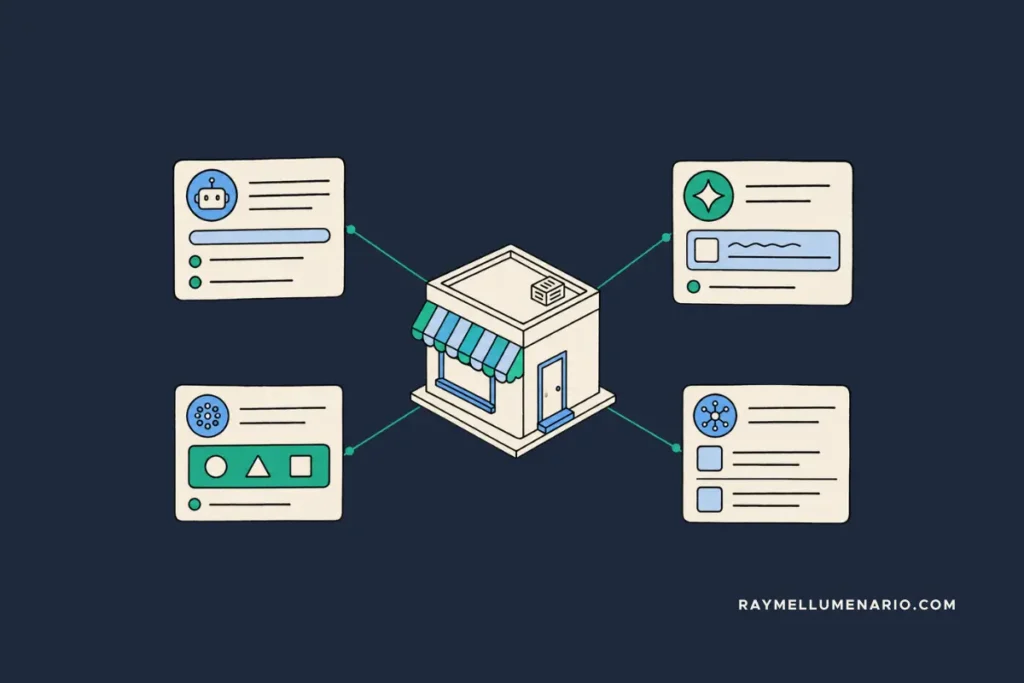
Getting your business cited by ChatGPT and AI Overviews means structuring your content, your third-party mentions, and your public presence so AI systems can find your business, trust it, and quote it directly inside an answer, without you paying for placement. Each system works a little differently. Microsoft Copilot is built directly on Bing, a fact Microsoft has confirmed since renaming Bing Chat to Copilot. For Enterprise and Edu workspaces, OpenAI says ChatGPT may share disassociated search queries with Bing to return web results. OpenAI also operates its own search crawler, OAI-SearchBot, for ChatGPT search visibility. Google’s AI Overviews and AI Mode pull from Google’s own Search systems. Claude hasn’t officially named its web search provider, but Anthropic’s own subprocessor list, documented independently by developer Simon Willison, added Brave Search in 2025. Perplexity blends its own index with other sources. None of this requires an enterprise SEO retainer to start.
Why Does Getting Cited by AI Matter More Than Ranking Well Right Now?
Google says plainly that there are no special files, schema, or optimizations required to appear in AI Overviews or AI Mode: a page just needs to be indexed and eligible to show a snippet in regular Search, the same technical bar as classic search results. That’s good news if you’ve been putting off AI-specific tactics waiting for a bigger budget: the foundation is the SEO foundation you already have, or can build without one.
Google has also said that clicks arriving from AI Overviews tend to be higher quality, meaning people spend more time on the page they land on. Whether that translates into more paying customers for your specific business is a separate question, worth testing with your own numbers rather than assuming. The idea that AI-referred visitors convert better is a reasonable hypothesis: someone who just had a detailed back-and-forth with an AI system about their problem is arguably further along than someone scanning a page of results cold. It isn’t a proven fact across businesses yet.
I covered the fundamentals of generative engine optimization for founders in an earlier post. This one goes further: what’s changed engine by engine since then, and how to check whether any of it is working without buying a monitoring tool.
It’s easy to assume AI visibility is fine because Google traffic looks healthy. That’s not always true. A site can block an unfamiliar crawler by default or carry a stray noindex tag, and neither one would necessarily show up in Google Search Console, since Search Console reflects Google’s own crawling activity, not every AI system’s. Ranking well and being reachable by AI crawlers are two separate problems, and only one of them shows up in the reports founders already check.
How Do You Check If ChatGPT and AI Overviews Are Actually Citing You, Without Paying for a Tool?
There’s a growing category of paid tools built just to track this: dashboards that monitor your brand across ChatGPT, Perplexity, and Google AI Mode, then benchmark you against competitors. They’re useful at scale. You don’t need one to find out where you stand today.
Ask the questions yourself, in each engine, directly
Open ChatGPT, Perplexity, Claude, and Copilot in separate tabs. Ask the exact questions a buyer would ask: who’s a good option for your service in your niche, what’s the best tool for your specific situation. Note whether you’re named, and whether a competitor gets named instead. Do this monthly, and log it somewhere simple, a spreadsheet tab is enough.
Check GA4 for the traffic that’s already arriving
Google Analytics publishes an official worked example for exactly this: setting up a custom channel group to isolate AI assistant traffic, with a suggested pattern matching ChatGPT, Gemini, Copilot, Claude, and Perplexity by source. In GA4, that’s under Admin, then Data display, then Channel groups.
Set it up, but don’t treat it as complete. Referrer information gets lost or stripped in plenty of ordinary situations, mobile apps and in-app browsers being common culprits, so any AI-traffic view built on referrer data will undercount. If your Direct traffic has increased unexpectedly, some AI-assisted visits may be included in that total, but referrer data alone cannot show how much.
Check your server logs for the crawlers, not just the visitors
Your own site being crawled is one signal, not the whole picture. An AI system can still mention or cite your business through a page it crawled elsewhere, a review site, an industry write-up, a directory listing, without ever visiting your domain directly.
Worth knowing before you check: the crawler that determines whether you show up in a company’s search results usually isn’t the same one used to gather AI training data. OpenAI runs OAI-SearchBot for search and a separate GPTBot for training, and blocking GPTBot doesn’t affect your ChatGPT search visibility at all. Anthropic runs the same kind of split: Claude-SearchBot for search quality, ClaudeBot for training, and Claude-User for live user requests. Perplexity’s crawler, PerplexityBot, is used for search and isn’t used for AI training.
So check your access logs, or your CDN’s logs if you’re on Cloudflare, for OAI-SearchBot, Claude-SearchBot, and PerplexityBot specifically, not the training-only bots. If none of them show up, treat that as something worth digging into, not proof your site is inaccessible. A robots.txt rule or firewall setting could be blocking the crawler, the crawler simply hasn’t reached you yet, or the page was served from CDN cache before the request ever touched your origin logs, in which case it wouldn’t show up no matter how accessible your site actually is.
Get cited by ChatGPT and AI Overviews: to have an AI system name your business, quote your content, or link to your site directly inside a generated answer, without paying for placement. Citation depends on structured, extractable content and consistent, validated mentions of your business elsewhere on the web, not on your search ranking alone.
What Should You Fix First to Earn More Citations?
Four things move the needle, and none of them need a developer.
Lead with the answer, not a pitch. A page that opens with a generic company introduction answers no question and gets skipped. Put the direct answer to the question someone’s actually asking in the first 100 words, on every page that matters.
Here’s the difference in practice. A services page that opens with a line like “a leading provider of marketing consulting for small businesses” gives an AI model nothing to extract, it’s a claim, not an answer. A page that opens with “I help founder-led teams under 20 people set up marketing systems without hiring a full-time marketer” gives it a direct, quotable sentence. Same business, same offer, one version is far easier for a model to lift into an answer.
Structure for extraction. Add an FAQ section with plain, direct answers, keep one clear H1 and descriptive H2s, and add structured data (Article, FAQ, Person schema). Google is explicit that this doesn’t guarantee inclusion in AI features, structured data just needs to match the visible text on the page as part of ordinary good practice, the same standard that applies everywhere else in Search. Treat it as giving search systems clearer context, not a citation guarantee.
Earn third-party mentions. A review site, a forum thread, someone else’s blog mentioning you carries a kind of credibility your own site can’t manufacture on its own. Exactly how much this outweighs your own site’s content isn’t something I can point to a solid, independent study for, but the logic holds regardless: a handful of real outside mentions is a reasonable use of time next to writing another page about yourself.
Keep it current. Refreshing pages on a deliberate schedule is a sensible editorial habit on its own, independent of any AI-visibility claim: it catches outdated information, keeps you relevant to what people are actually asking, and gives you a reason to revisit and improve older content. Treat it as good practice, not a guaranteed traffic lever.
What’s the Claude and Brave Search Situation?
Claude appears to use Brave Search for at least some of its web results, though Anthropic hasn’t confirmed the mechanics publicly. Anthropic’s own subprocessor list added Brave Search in 2025, which is the clearest evidence available so far.
If it holds up, ranking well on Google doesn’t necessarily carry the same weight with Claude that it does with Google’s own AI Overviews, since it may be pulling from a different index. Checking whether Brave surfaces your business at all takes five minutes: search your own business name and domain directly on search.brave.com and see what comes back. It won’t confirm anything about Claude specifically, but it’s a reasonable, free way to see whether Brave has indexed you.
How Does This Fit Into a Weekly Marketing Review?
None of this needs its own dashboard or its own hour every week. I run it inside the same lean marketing framework I use for everything else: pick one thing to track, check it on a fixed schedule, and only add a new tool once the manual version stops being enough.
For this specific check, that means one added item in the same weekly 20-minute review: open ChatGPT, Perplexity, and Claude, ask your two or three most important buyer questions, and note what changed since last week. Once a month, glance at the GA4 channel group and your server logs for anything new.
The mistake I see most often isn’t skipping this entirely. It’s founders who run the check once, get discouraged or excited by a single result, and never look again. A citation you don’t see this week can show up next month once a crawler catches up, and one you have this month can disappear if a competitor earns a stronger third-party mention than yours.
Where Should You Actually Start This Week?
You don’t need to do all of this at once, and trying to is how it gets abandoned by week two. In order:
- Ask ChatGPT, Perplexity, and Claude your two or three most important buyer questions today, before changing anything, so you have a starting point to compare against.
- Rewrite the first 100 words of your homepage and your top two service pages so they answer a question instead of introducing your company.
- Set up a custom GA4 channel group for AI assistant traffic, using Google’s own example configuration as a starting template.
- Check search.brave.com for your own business name, and check your server logs for OAI-SearchBot, Claude-SearchBot, and PerplexityBot, to see whether these crawlers are reaching your site at all.
- Pick one third-party mention to earn this month, a review, a guest mention, a forum answer, rather than adding another page to your own site.
By the end of the month, you’ll have a before-and-after answer to the same set of buyer questions, real traffic data instead of a guess, and a clearer read on whether the crawlers can reach you. That’s a practical citation check, done without a subscription.
Frequently Asked Questions About Getting Cited by ChatGPT and AI Overviews
Do I need to rank on page one of Google to get cited by ChatGPT?
Not necessarily. Copilot is built on Bing, and ChatGPT’s search feature shares queries with Bing too, so your Google ranking matters most for Google’s own AI Overviews and AI Mode specifically. Claude may draw on Brave Search results for at least some queries, based on third-party reporting rather than official confirmation. Structured, clearly written content can still get cited by other engines independently of where you rank on Google.
How long does it take to start showing up in AI answers?
There’s no reliable published timeline for this across engines. It depends on how often each engine’s crawler revisits your pages and how quickly new third-party mentions accumulate, both of which vary too much to put a single number on.
Do I need a paid AI citation tracking tool to get started?
No. Manually testing your priority questions in each engine, plus a custom GA4 channel group and a look at your server logs, covers what most small businesses need before a paid tool earns its cost.
Does getting cited by AI actually bring in customers, or just visibility?
Potentially both, though the customer half is still more hypothesis than proven fact. Google has said AI Overview clicks tend to run higher on time spent per page, but whether that extends to more conversions for your specific business is worth testing against your own numbers rather than assuming.
Is setting up an llms.txt file worth it?
It’s low-cost, usually well under an hour of work. But SE Ranking’s analysis of roughly 300,000 domains found no correlation between having an llms.txt file and getting cited more often by AI systems. Worth flagging that this is vendor research from an SEO tool company, not independent academic research, but it’s the largest look at the question so far. Treat llms.txt as an optional, low-risk experiment, not a citation strategy to rely on.
If you want to go deeper on the lean systems behind this, raymellumenario.com is where I share more.