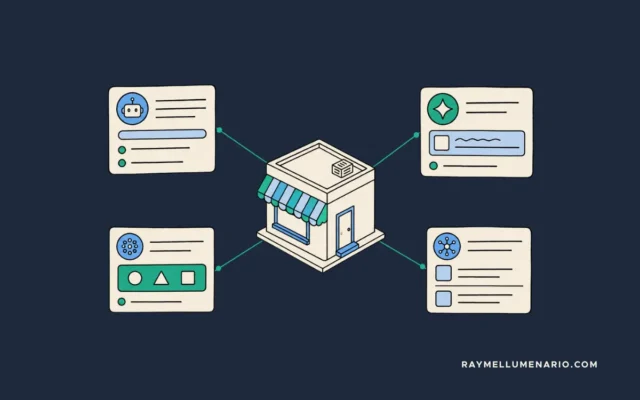
Only 38% of the answers ChatGPT, Google’s AI Overviews, and Perplexity give people today come from a page sitting in the top 10 organic results. Ranking well and getting cited by AI are no longer the same game.
Generative engine optimization for founders means structuring your website, your content, and your public presence so AI systems like ChatGPT, Google AI Overviews, and Perplexity can find, trust, and quote your business inside their answers. It works differently from traditional SEO. Instead of chasing a ranking position, you’re building the kind of clear, structured, consistently repeated information an AI model can lift directly into its response.
Why Founders Can’t Ignore Generative Engine Optimization Anymore
Most of what’s written about generative engine optimization right now is written for agencies managing six-figure retainers, not for a founder running marketing alone on a Tuesday afternoon. That’s the gap I’m writing into here.
AI referral traffic to small business websites has more than doubled in under a year. People are asking ChatGPT and Perplexity “who should I hire for X” or “what’s the best tool for Y” before they ever open a search engine, and the businesses getting named in that answer are pulling ahead of the ones that aren’t, regardless of how well those businesses rank.
This isn’t a future problem. It’s a current one. If your business isn’t structured to be citable, you’re invisible in a growing share of buying decisions, even if your Google ranking looks fine.
What Is Generative Engine Optimization, Exactly?
Generative engine optimization, GEO, is the practice of shaping your content and public presence so generative AI systems can retrieve it, trust it, and use it to answer someone’s question directly, instead of just linking to it.
Traditional SEO optimizes for a click. GEO optimizes for a quote. The AI reads your page, decides it’s a reliable source, and repeats what you said, sometimes with a link back, sometimes without one.
Generative engine optimization for founders: the practice of structuring a small business’s website, content, and third-party mentions so generative AI systems can retrieve, trust, and cite the business directly inside AI-generated answers. Unlike traditional SEO, it does not depend on ranking position. It depends on structured content, clear definitions, and consistent entity recognition across the web.

How Is GEO Different From Traditional SEO?
Traditional SEO is a ranking game. Beat the page above you, and you get the click. GEO doesn’t work that way, which is the part most founders coming from an SEO background get wrong first.
By early 2026, only 38% of AI Overview citations came from pages already ranking in the top 10 organic results. Semantic completeness, structured data, and clear authorship signals now influence whether AI cites you independently of where Google ranks you.
I’ve seen two businesses rank in nearly identical positions for the same keyword, and only one gets quoted in AI answers. The difference wasn’t authority or backlinks. It was that one had a clean, extractable definition and a direct answer near the top of the page, and the other buried the same information three paragraphs deep in a sales pitch.
What Actually Gets a Small Business Cited by AI Search Engines?
Four signals do most of the work, and none of them require an enterprise SEO budget.
Structured data. Pages using schema markup show roughly a 73% improvement in AI Overview selection rates. This is the single highest-leverage technical change most founders haven’t made yet.
FAQ formatting. Structured question-and-answer pairs get cited by AI systems at a notably higher rate than the same information written as a paragraph, simply because they’re easier for a model to lift out cleanly.
Consistent brand mentions. Being mentioned across Reddit threads, review sites, industry write-ups, and your own site, all with the same name and positioning, correlates roughly three times more strongly with AI visibility than backlinks do.
Recency signals. Content with a visible year in the title or headings sees a meaningful lift in citation rate. AI systems are biased toward what looks current, the same way people are.

Where Should a Founder Start With No Budget and No Team?
- Add basic schema markup (Article, FAQ, Person) to your most important pages. Most SEO plugins do this for free.
- Rewrite your key pages so the direct answer appears in the first 100 words, not buried after the pitch.
- Turn your most common sales-call questions into an actual FAQ section, worded the way people actually ask them.
- Get your business named consistently in three to five places outside your own site: a review platform, a relevant subreddit or forum, a guest mention on someone else’s blog.
- Keep a visible year in your titles and headings where it’s accurate to do so.
None of this requires a developer or a retainer. It requires rewriting what you already have so a machine can extract it cleanly.
The Signal Most GEO Guides Skip
Entity consistency predicts AI citation more reliably than content volume does. Most founders respond to GEO advice by publishing more content. The better move is making sure the content you already have says your name, your positioning, and your core claims the exact same way, every single time, everywhere it appears.
An AI model builds confidence in a source the same way a person builds confidence in a rumor: through repetition from multiple directions. Five consistent mentions across different platforms will out-cite fifty inconsistent ones. This is the practitioner insight most GEO content misses entirely, because it’s easier to sell “publish more” than “say the same thing everywhere.”
I covered the measurement side of proving any of this is working in how to measure marketing ROI without a big analytics stack, since AI referral traffic needs to be tracked the same disciplined way any other channel does.
As a growth marketing consultant, I work with this framework directly with founder-led teams who need to show up in AI answers without hiring an agency to do it.
Frequently Asked Questions About Generative Engine Optimization for Founders
Is generative engine optimization different from SEO, or part of it?
It’s related but distinct. Traditional SEO earns a ranking position and a click. GEO earns a citation inside an AI-generated answer, which can happen independently of your ranking position.
Do I need to rank on page one of Google to be cited by ChatGPT?
No. Only a minority of current AI Overview citations come from top-10 organic results. Structured, clearly written, well-defined content can get cited regardless of ranking.
How long does it take to see results from generative engine optimization?
Most businesses see early citation lift within 90 to 120 days of consistent structural changes, with fuller entity recognition building over several months.
What’s the single highest-impact change a founder can make first?
Adding structured data (schema markup) to your key pages. It’s the technical change with the clearest measured lift in AI Overview selection, and most SEO plugins can add it without custom development.
If you want to go deeper on lean marketing systems like this one, raymellumenario.com/blog is where I share more.