Most advice about a small business marketing budget starts with a percentage of revenue. That gives you a number. It does not tell you whether you can sustain the spending, where it should go, or who has time to do the work.
I would start with three questions: What can the business safely commit? What is limiting growth right now? What result would justify spending more?
The short answer: Set a monthly marketing budget you can sustain for 90 days. Include the full cost of people, production, tools, and promotion. Put most of the flexible money toward the step that is stopping qualified prospects from becoming customers. Review what happened before adding another channel.
The U.S. Small Business Administration says there is no fixed percentage that fits every business. A revenue percentage can be a useful reference, but it should not make the decision for you.
Count the full cost of marketing
Your marketing budget is more than your ad spend. Depending on your plan, it may include:
- People: contractors, consultants, or employee time.
- Production: landing pages, copy, design, photography, video, and email.
- Promotion: ads, sponsorships, events, or other paid distribution.
- Systems: your CRM, email platform, forms, analytics, and call tracking.
If you do the work yourself, record the hours alongside the cash cost. A plan with cheap software can still be expensive if it takes ten hours a week that you do not have.
Separate one-time costs from recurring costs, too. Rebuilding a landing page this month is a different commitment from running ads every month. You need to know which bills will repeat.
Step 1: Set a 90-day spending ceiling
Start with cash the business can commit without putting payroll, taxes, delivery, or its normal buffer under pressure. Multiply the monthly amount by three. That is your test ceiling, not a requirement to spend every dollar.
Say you can safely commit $1,500 a month. Your 90-day ceiling is $4,500. If that only works when you assume new sales will arrive immediately, lower the number. A service business may wait weeks between an inquiry and a signed client.
You can compare your ceiling with a revenue-based estimate. For example, 5% of $20,000 in monthly revenue is $1,000. That calculation is a reference point, not a recommended rate. Two businesses with the same revenue can have very different margins, cash reserves, and growth capacity.
My free Marketing Budget Calculator gives you a directional range and channel priorities based on revenue, niche, and growth stage. Check its result against your actual cash and the time your team can give the work.
Step 2: Decide how much new business you can handle
Before paying for more leads, ask how many new customers you could serve well next month.
Write down:
- How many new customers can you realistically onboard?
- How many qualified opportunities does it usually take to win one?
- How long does it take from first inquiry to sale?
Use recent CRM records, invoices, and form submissions to make a rough baseline. If you do not have enough data yet, mark the gaps. Do not turn a guess into a precise acquisition target.
If your team can take on two new clients, paying for twenty more inquiries may create a follow-up problem rather than growth. Capacity belongs in the budget decision.
Step 3: Find the constraint before choosing a channel
Trace the route to a sale:
Relevant visits → inquiries → qualified opportunities → booked conversations → customers
Where do people stop moving? That is where I would look first.
| What you see | Where to focus spending |
|---|---|
| Few relevant visitors, but the leads you get tend to buy | Expand the source already bringing qualified prospects, or test one related source. |
| Plenty of visitors, but few inquiries | Improve the offer, page, form, and call to action before buying more traffic. |
| Many inquiries, but few are a good fit | Improve targeting and qualification. |
| Qualified people inquire, but few book a call | Fix routing, scheduling, and follow-up. |
| Calls happen, but few customers close | Examine the offer, sales process, pricing, and customer fit. |
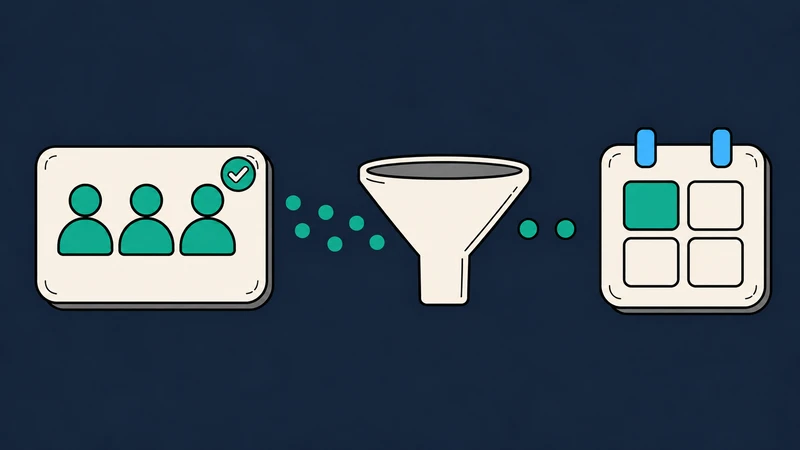
You do not need a complex dashboard. A spreadsheet or CRM that records each lead’s source, qualification, next step, and outcome will give you a place to start. My guide to the marketing metrics that connect to revenue covers the numbers I would track.
Step 4: Give most of the flexible budget one job
Once you know the constraint, fund a focused improvement. Keep enough for basic tracking and for the source that already works. Splitting a small budget across every possible channel makes it hard to learn what helped.
Here is an illustrative first-month budget, not a standard split:
A founder-led service business can commit $1,500 this month. It receives relevant inquiries, but qualified prospects often fail to book a call. It spends $300 on lead tracking and routing, $800 on its booking page and follow-up process, and $400 to maintain its existing source of inquiries. Total: $1,500.
At the end of the month, the useful question is whether more qualified inquiries reached a booked conversation. A traffic increase would not answer it.
If the booking rate improves, the business can consider spending more to bring in prospects. If it does not, more traffic feeds the same leak.
Another business might have strong conversion and too few inquiries. Its primary move could be a focused search campaign, a partner program, or content that answers a buyer’s specific question. The constraint determines the allocation.
Step 5: Review results before raising the budget
Review spending and lead quality each month. Judge customer outcomes over a period that fits your sales cycle. If deals take several weeks to close, one month’s revenue may be a poor measure of that month’s marketing work.
Keep the review short:
- What did you spend, including tools and production?
- Which source brought qualified opportunities?
- Where did those opportunities stop moving?
- How many became customers, and how long did that take?
- What will you keep, change, or stop next month?
Compare the cost of acquiring a customer with the gross profit that customer is expected to contribute, rather than revenue alone. If you have too little data for a reliable comparison, say so. You can still fix a clear follow-up problem while building a better baseline.
Increase spending when a source repeatedly brings qualified customers, the economics work, and your team can serve the extra demand. Hold or reduce it when lead quality falls, follow-up is broken, or you cannot tell what the money produced.
Give the budget a clear job
A useful small business marketing budget is an amount you can sustain and learn from. Set a safe ceiling. Count the full cost. Find the constraint. Fund one clear improvement. Then use customer outcomes to decide what earns more money.
If you need a starting range, use my free Marketing Budget Calculator. It gives you a place to start, then the steps above help you decide what to fund first.
Frequently asked questions
What percentage of revenue should a small business spend on marketing?
There is no percentage that works for every business. Use a benchmark as a starting point, then check it against available cash, margins, growth goals, sales cycle, and team capacity. The SBA’s guidance also treats revenue percentages as guides rather than fixed rules.
Is ad spend the same as a marketing budget?
No. Ads are one possible cost. A complete marketing budget also accounts for the people, assets, tools, and systems needed to turn interest into customers.
What if I cannot afford paid ads?
Start with the strongest source of qualified opportunities you already have. That might be referrals, search traffic, a partner, or an email list. Protect time for the work, follow up consistently, and record what produces real opportunities.
How often should I change my marketing budget?
Review it monthly. Make larger changes when you have enough evidence for your sales cycle. Change sooner if the business cannot safely sustain the spending or if a clear tracking or follow-up problem is wasting it.